
Eight signs · four that matter
The signs of a hidden water leak, and the ones that mean nothing
Under a slab, water does not stay where it escaped. It travels through the fill until it finds a way up, which is why the damp patch is evidence of travel and not a location.
- CFC1433655Florida plumbing contractor license
- Eight signsand what each one actually means
What are the signs of a water leak you cannot see?
The reliable ones are a bill that climbed with no change in how much water you use, the sound of running water when nothing is running, a patch of floor that is warm underfoot, and a meter that keeps moving after everything in the house is shut off. Those four point at a real leak often enough to be worth acting on.
The unreliable ones are equally common and get treated as proof far too readily: a musty smell, a hairline crack in a wall or a tile, a patch of unusually green lawn, and low water pressure. Each of these has several innocent explanations in a subtropical climate, and each of them also accompanies a genuine leak, which is exactly what makes them useless on their own.
The one test that settles it costs nothing and takes twenty minutes, and it is the meter. Everything else on this page is a reason to go and run that test rather than a conclusion by itself.
Sign by sign
What each sign is actually telling you
These are ordered by how much weight they deserve, not by how often people mention them.
A bill that rose without a reason
The strongest single sign, because water is metered and the meter does not have opinions. Compare against the same month last year rather than against last month, since irrigation and houseguests move usage seasonally. A step change that persists across two or more billing periods, with nothing in the household having changed, is a leak until proven otherwise.
Running water you can hear with everything off
Stand in a quiet house at night with every fixture closed and listen near walls and floors. A faint continuous hiss or trickle is pressurized water escaping. It is worth trusting, and it is worth noting where it is loudest, though on a slab the loudest point is where the sound conducts best rather than necessarily where the break is.
A warm spot on the floor
This one is close to diagnostic and it is specific to hot water lines. A patch of tile or laminate that is noticeably warmer than the floor around it, in a place with no sunlight and no appliance, generally means a hot line is leaking under the slab. It is also the sign people most often dismiss, because a warm floor does not feel like an emergency.
The meter moving with the house shut down
The only one of the eight that is a measurement rather than an inference. Close everything, watch the low flow indicator or take a reading twenty minutes apart, and a change means water is leaving the system. There is a companion article on this site that walks through it, including the second test that says whether the leak is inside the building or in the buried run outside.
A musty smell
Weak on its own. This is a humid region and bathrooms, closets and air handler cabinets smell musty for reasons that have nothing to do with plumbing. A musty smell that is new, localized to one part of the house, and accompanied by any of the four strong signs is worth taking seriously. On its own it more often points at ventilation or at the air conditioning condensate line.
Cracks in tile, drywall or the foundation
Frequently blamed on leaks, and occasionally caused by them, but the ground here moves for its own reasons. Sandy fill settles, the water table rises through storm season and falls back, and buildings crack. A crack that appears suddenly and grows, especially alongside a floor that has gone soft or a door that has stopped closing, deserves attention. An old hairline crack that has been there for years is just an old crack.
A green patch in the lawn
Genuinely useful, but almost never about the house. A single patch of grass that is greener, lusher or wetter than everything around it, particularly in a line between the meter and the building, points at the buried service line. It is also, very often, an irrigation head that leaks, which is a different system and a much smaller job. Rule the irrigation out first.
Low water pressure
The least useful sign on the list. Pressure drops because of a partly closed valve, a clogged aerator, a failing pressure regulator, scale in old galvanized pipe, or something the utility is doing at the street. A leak large enough to drop pressure across a whole house is usually large enough to have announced itself some other way.
Why the wet spot is not the leak
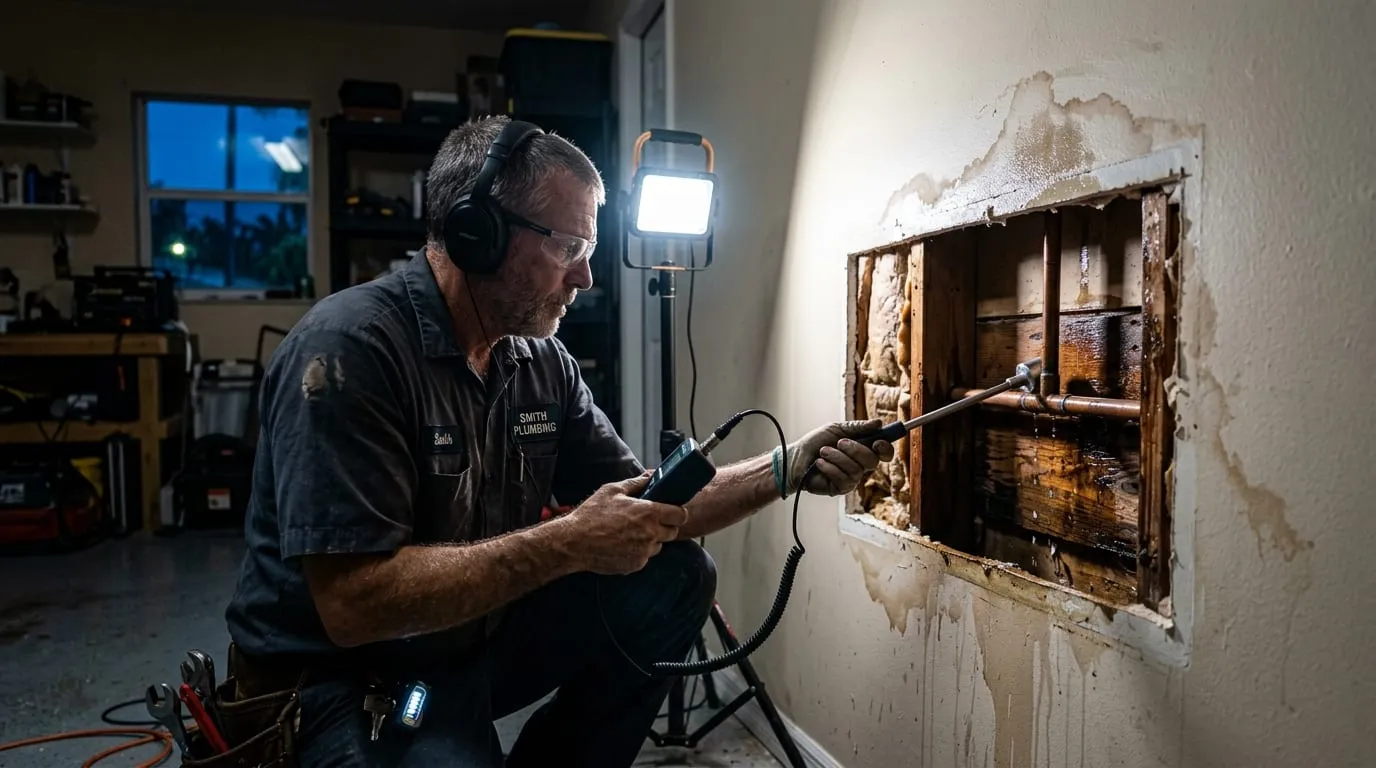
This is the local mechanism that generic advice gets wrong. Almost every house here is slab on grade, and the water table is shallow. Water leaving a pressurized line under concrete does not pool where the pipe failed: it moves through the fill under the slab until it finds a seam, a crack, an expansion joint or the lowest point in the floor, and that is where it surfaces. So the damp baseboard tells you water is arriving there, and very little about where it started. That is the entire argument for locating a leak with acoustic and thermal equipment before anybody opens a floor.
Questions
Common questions about hidden leaks
How do I tell a slab leak from a roof or air conditioning leak?
Timing and temperature. Water that appears in relation to rain points at the building envelope, and water near an air handler or along its drain line points at condensate. A leak that runs continuously regardless of weather, and shows on the meter with everything closed, is a supply leak.
Can a hidden leak show up on the bill before it shows anywhere else?
Very often, and that is why the bill is the strongest early sign. Under a slab a leak can run for months before enough water surfaces to be noticed, and the meter records every gallon of it the whole time.
My floor is warm in one spot. Is that definitely a leak?
It is one of the more reliable indicators, though it only applies to hot water lines and it can also be caused by something under or near the floor generating heat. The meter test with everything shut off is what converts the suspicion into a fact.
Does homeowners insurance cover this?
It varies by policy and by cause, and it is a question for the insurer rather than for a plumber. What is worth knowing is that policies commonly distinguish between the damage the water caused and the repair of the pipe itself, so documenting the date you first noticed it is useful.
How long can I leave it?
Water running under a slab does not stay contained. It undermines fill, saturates the subfloor, and reaches finishes and cabinetry, and the cost of that is not related to the size of the hole in the pipe. A leak found early is a repair; the same leak found late is a restoration.
Related
What this connects to
The pages this article usually leads to.
Live dispatch · 24 / 7 / 365
Bill up, meter moving, nothing visible?
That combination is a leak under the slab often enough to be worth locating properly. A person answers at any hour.
No obligation. Work performed under Florida plumbing contractor license CFC1433655.