
Answered 24/7 · you watch the footage
Camera inspection, so the quote follows the evidence instead of the guess
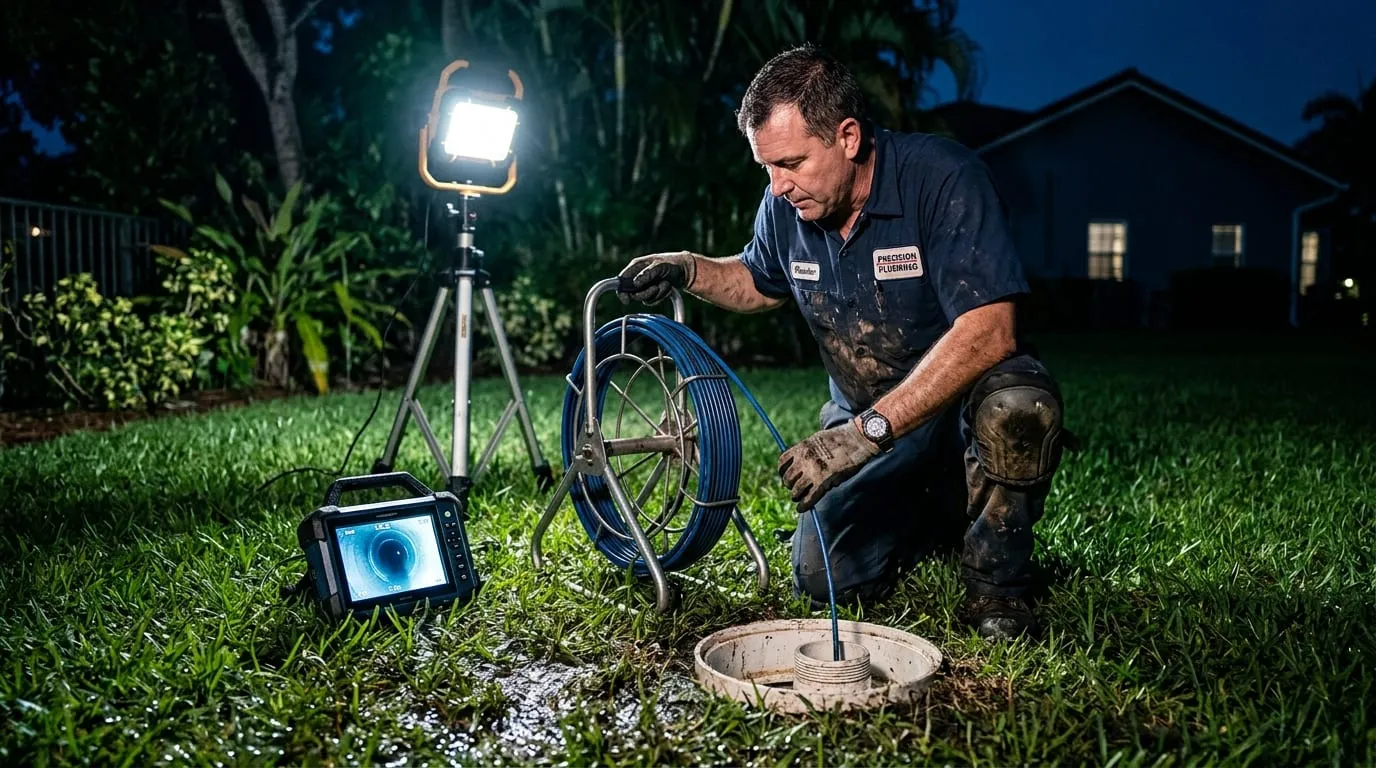
A camera is run the length of the line from an access point, and what it finds is recorded and shown to you, so the scope of any repair is decided by footage rather than by opinion.
- CFC1433655Florida plumbing contractor license
- You see the footagenot a description of it
Why put a camera in before repairing anything?
Because everything expensive that follows depends on facts a camera provides and nothing else does: what the pipe is made of, where the defect is, how long the failed section actually runs, and whether the rest of the line is sound. Without that, a scope is an estimate of an unknown, and the safe way to price an unknown is to assume the worst of it.
In South Florida the specific question is usually cast iron. Drain lines in houses built roughly between 1945 and 1975 are cast iron, and a camera separates the run that has genuinely failed from the run that is only scaled. Those are very different jobs, and the difference is often most of the cost.
It also answers the question that decides who pays. Where the defect sits relative to the property line changes whether it is yours or the utility’s, and that is worth establishing before anyone opens ground.
When it is worth doing
The moments a camera saves money rather than adds to a bill
Not every drain problem needs one. These do.
A clog that has come back twice
Two clearings in a year is the pipe telling you something about its condition. A third clearing is an expensive way of not finding out what.
Before you accept a quote to replace a line
Scope is where the money is. Footage is what turns a proposed length of replacement into a length you can check.
Before buying an older house
In a house from the cast iron era, the drain line is one of the few major systems a normal inspection does not see. It is also one of the most expensive to be wrong about.
Before anyone cuts a slab
Opening concrete is the point of no return. Knowing exactly where and how far along the failure sits is worth an hour beforehand.
When the responsibility boundary matters
If the defect is close to the property line, whether it falls on your side or the utility’s changes who does the work. That is a measurement, not an argument.
How the job goes
From an access point to a decision you can check
Three steps, and you keep the footage at the end of them.
- 01
Find or make an access point
Usually a cleanout. If the property has none, that is itself a finding, because the county requires a property line cleanout in some jurisdictions and it is what gives access to the run beyond it.
- 02
Run the line and locate what matters
The camera goes the length of the run. Where there is a defect, its position is located from the surface so a repair can be placed rather than searched for.
- 03
Watch it, then decide
You see the footage rather than a description of it, and the recommendation comes with the frame that justifies it. A camera that finds sound pipe is a good result, not a wasted visit.
Questions
Straight answers before you call
Do I get to keep the footage?
Yes, and you should insist on it from anyone. A recommendation that comes with the video is checkable by a second opinion; one that comes without it is not.
Can a camera find a leak in a supply line?
No. A camera goes down drains, which are open pipes. A pressurized supply leak is found by acoustic listening, thermal imaging and pressure testing, which is a different service and a different tool.
What if there is no cleanout?
Then access is through a fixture or a pulled toilet, or a cleanout gets installed. Not having one is worth knowing about anyway: in parts of Miami-Dade the property owner is responsible for installing a property line cleanout, and it is what gives access to the county-maintained run.
Will it tell me whether I can line the pipe instead of digging?
It is the only thing that will. Lining needs a passage for the liner, so a cracked or root-damaged pipe is usually a candidate and a collapsed or badly offset one is not. That is a judgement made from footage.
Related work
What a camera usually leads to
The point of the inspection is choosing correctly between these.
Live dispatch · 24 / 7 / 365
About to accept a quote for a drain line?
A person answers at any hour. Put a camera in first, and the scope becomes something you can check rather than something you have to trust.
No obligation. Work performed under Florida plumbing contractor license CFC1433655.