
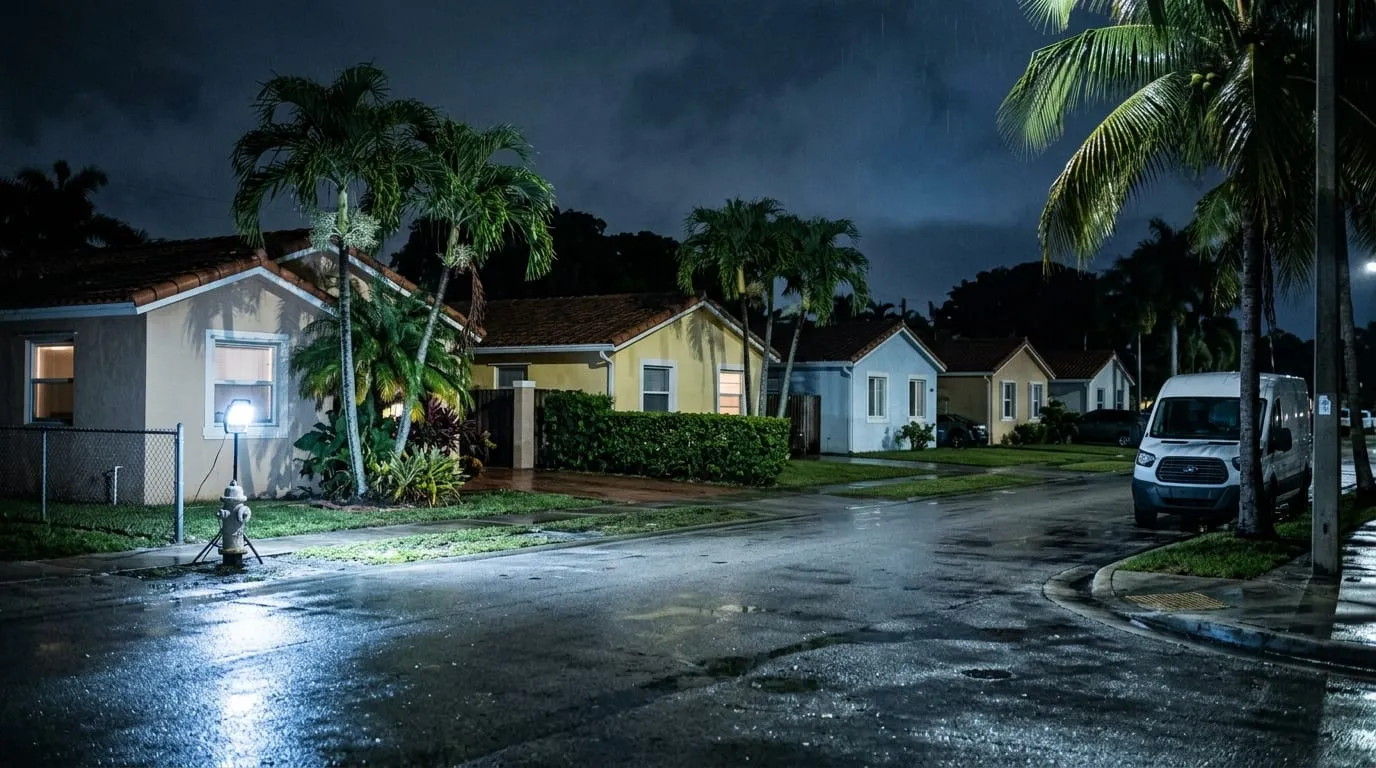
Season runs June through November
The storm season plumbing checklist, and why it belongs in March
Almost everything that goes wrong with plumbing in a storm is groundwater arriving somewhere it should not. That is preventable in the dry months and largely unfixable in the wet ones, when every contractor in three counties is already committed.
- CFC1433655Florida plumbing contractor license
- June to Novemberdo this work before it
What actually goes wrong with plumbing during storm season?
Not wind, in most cases. The recurring failures are groundwater ones. Heavy rain raises an already shallow water table, water finds its way into sanitary sewers through cracked pipe, faulty connections and open manholes, and the system receives far more than it was sized for. When it exceeds capacity, it backs up, and it backs up into buildings at the lowest opening available.
That is the mechanism worth understanding, because it explains why a house that has never had a drainage problem gets one during a storm, and why the backup often appears in a ground floor shower or a floor drain rather than at the fixture anybody was using.
The other failures follow from the same rise. A septic drainfield cannot disperse into saturated ground. A well pump has no power. A sump pump discovers it has not run in a year at the moment it is needed. None of these are repairable while the water is up.
The checklist
Seven things to do before the season, and three for the days before a storm
Split deliberately. The first list needs a dry month and sometimes a contractor. The second list is what you can do in an afternoon when something is forecast.
Before the season
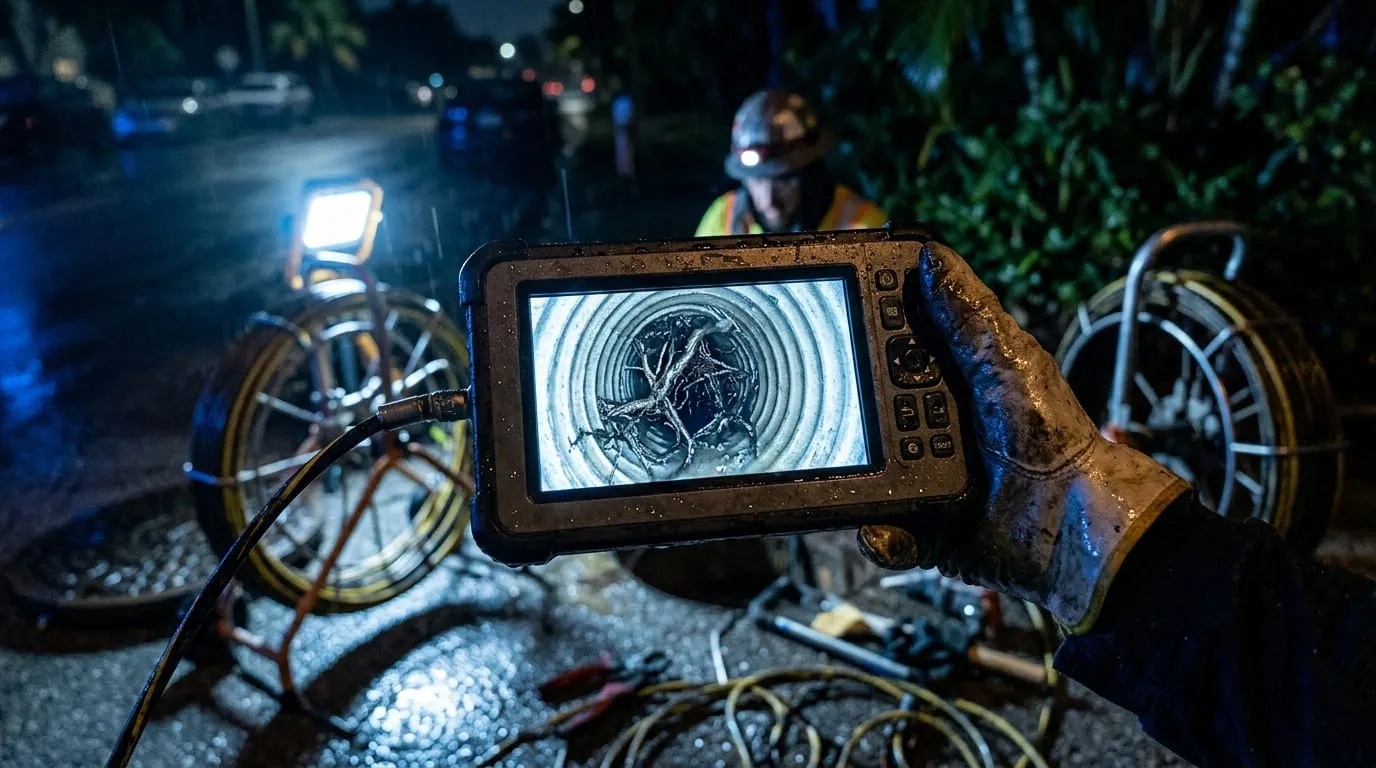
- Have the sewer lateral inspected if the house is older. Cracked pipe and failed joints are how groundwater gets into the sanitary system in the first place, and a line that is marginal in April is the one that backs up in September. This is also the single most useful thing to do if you have had a storm backup before.
- Test the main shut-off. Close it, confirm the taps run dry, open it again. A valve that has not moved in years can seize, and finding that out during an emergency is the worst possible timing. There is a separate article on this site about locating it.
- Pump the septic tank if it is due. Florida intervals are shorter than the national rule of thumb, roughly every two to three years rather than three to five, because of sandy soil, a shallow water table and heavy rain. Larger households can need it more often. Doing it before the season rather than after is the whole point.
- Run the sump pump, if you have one. Pour water into the pit and watch it start, lift, and shut off cleanly. Check where it discharges to, and confirm that it is not somewhere that will be underwater itself.
- Look at the water heater and its surroundings. Particularly if it sits in a garage or a low area. A unit standing in floodwater is not a unit you restart, and knowing in advance how it is fed and how to isolate it is worth the five minutes.
- Clear the drains that take rain away from the building. Yard drains, area drains, and the gutters and downspouts feeding them. This is not strictly plumbing and it is the thing that most often decides whether water ends up against the building.
- If you are on a well, plan for the power. No power means no pump means no water at all, which is a different situation from a city supply that keeps flowing. Decide in advance what the household does about drinking water and sanitation.
In the days before a storm
- Fill containers for washing and flushing. Separate from drinking water. A bathtub of water is what lets a toilet keep working when supply or pressure goes.
- Do not run laundry, dishwasher or long showers during the worst of it. If the sanitary system is already surcharged, adding to it makes a backup into your own building more likely, and this is the one control you actually have during the event.
- Know where the main shut-off is, and tell somebody else in the house. If a supply line fails while you are away or the water goes off and comes back with a surge, this is the first thing anybody needs.
What to do if it does back up
Stop using water in the building immediately, because everything you send down adds to what is already trying to come back. Keep people away from the water: a sanitary backup is contaminated regardless of what it looks like. Photograph it before anything is cleaned, since that is the record for an insurer. And report it, because if the surcharge is in the public system rather than in your lateral, the utility needs to know and the responsibility question is different.
Why March and not September
Two reasons, and the second is the one people underestimate. The obvious one is that the work is impossible when the ground is saturated: you cannot pump a tank into a flooded drainfield, and you cannot properly inspect or repair a lateral that is underwater. The less obvious one is availability. When a storm passes, every plumber, restoration firm and equipment supplier in three counties is committed at once, and the queue is measured in weeks. Preventive work has a schedule; storm work does not.
Questions
Common questions about storm season plumbing
Why does my shower back up when it rains hard?
Because rain and groundwater are getting into the sanitary sewer through cracks and faulty connections, the system exceeds its capacity, and it backs up at the lowest opening it can find. In many houses that is a ground floor shower or a floor drain.
Should I turn the water off before a storm?
It is a reasonable precaution if you are leaving the property, and it removes the risk of a supply failure running unattended. If you do, open it slowly on your return, because a fast open sends a pressure surge through the whole system.
Is a backwater valve worth fitting?
It is the device that addresses this specific failure, and whether it suits your property depends on the layout of the drainage and on local requirements. It is a question to raise during the dry months, since it is installation work rather than an emergency fix.
My septic is due but the season has started. Do I wait?
Do not wait for the season to end. A tank that is due going into a wet period is more likely to fail when the ground is saturated, and the interval here is already shorter than the national rule of thumb for exactly that reason.
The water came back on brown after the storm. Is that dangerous?
Discolored water after a supply interruption is common and usually sediment disturbed by pressure changes. What matters is whether the utility has issued a notice about the water, so check that first and follow it rather than judging by appearance.
Can I run my well pump on a generator?
Many people do, and the details matter: the pump has a starting load well above its running load, and the connection needs to be made safely rather than improvised. It is worth establishing before the season what your pump needs and how it would be connected.
Related
What this connects to
The pages this article usually leads to.
Live dispatch · 24 / 7 / 365
Backed up during a storm before?
Then the lateral is worth looking at in the dry months, because the same thing will happen again. A person answers at any hour.
No obligation. Work performed under Florida plumbing contractor license CFC1433655.