
Five minutes now · saves a rebuild later
Where the main shut-off is in a South Florida house, and which way it turns
Four common locations, how to tell which one you have, and how to confirm the valve actually closes rather than assuming it will when it matters.
- CFC1433655Florida plumbing contractor license
- Do it todaynot during an emergency
Where is the main water shut-off in a Florida house?
In one of four places, and which one depends on the house rather than the city. Most commonly it is at the front of the property near the street, in a rectangular concrete or plastic box in the ground next to the meter. Second, on an exterior wall, often on the side of the house nearest the street and frequently near the hose bib. Third, in a garage or utility area where the supply enters the building. Fourth, in a mobile home, at the home itself rather than at a street box.
There is no basement here and usually no crawlspace, so the one place it will not be is where most online advice tells you to look.
Turning it is almost always clockwise to close. A round handle takes several full turns; a lever handle takes a quarter turn and is closed when the lever sits across the pipe rather than along it.
Do this today
Find it, turn it, and put it back
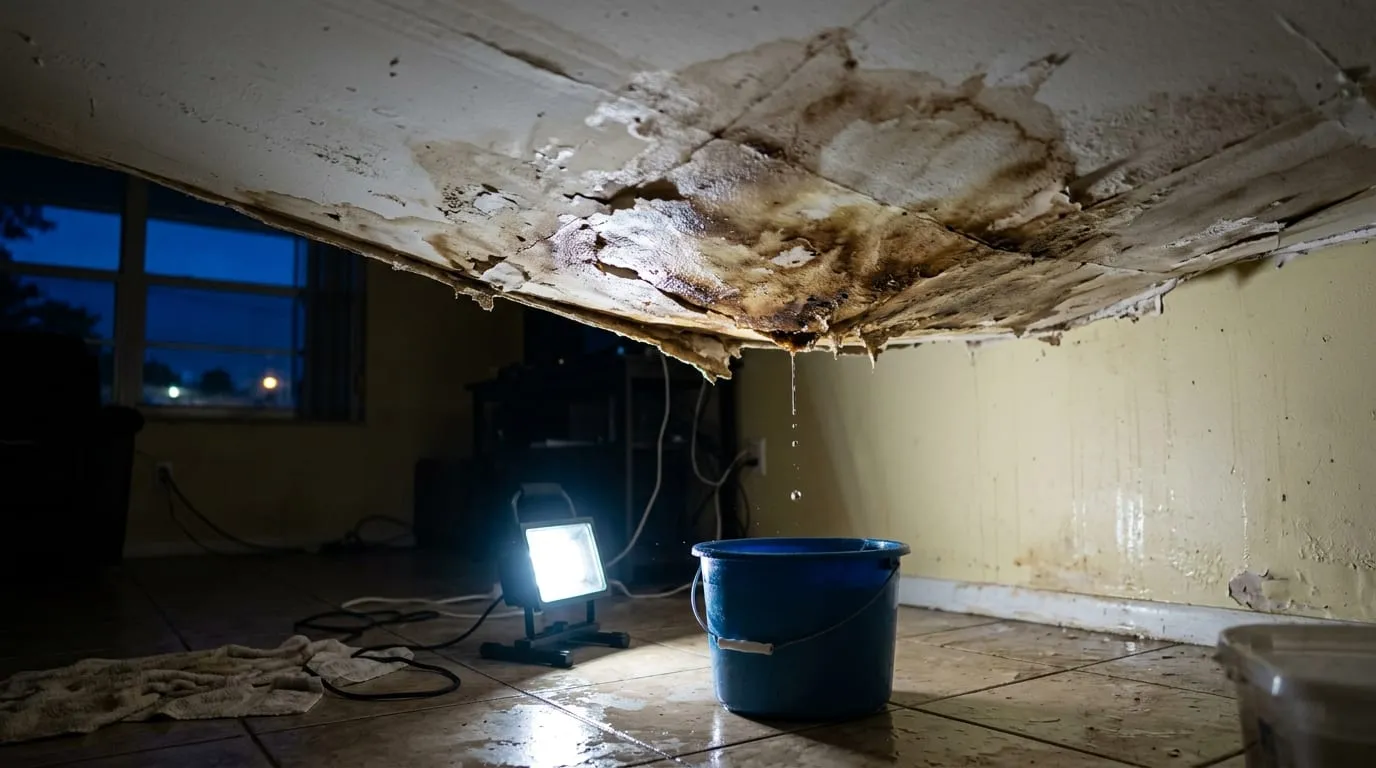
The single most useful five minutes a homeowner can spend is finding this valve while nothing is wrong. In an emergency the difference between a repair and a rebuild is usually measured in how long the water ran, and that is decided in the first two minutes by somebody who either knows where the valve is or does not.
Step one: find the meter box
Start at the front of the property, on the side nearest the street. You are looking for a rectangular lid in the ground, usually concrete or heavy plastic, often lettered WATER. Inside there is a meter and, on the house side of it, a valve. That valve is yours. The one on the street side of the meter belongs to the utility and should be left alone.
Step two: check the building too
Many houses also have a shut-off where the supply enters the structure, on an exterior wall or inside a garage or utility space. If yours has one, that is usually the more convenient valve, because it is above ground and reachable without a tool.
Step three: actually turn it
This is the part people skip, and it is the part that matters. A valve that has not moved in twenty years can seize, and discovering that at two in the morning with water running is the worst possible moment to find out. Close it, confirm the taps run dry, then open it again fully.
If it will not turn, or turns and does not stop the water, that is a job worth doing on a Tuesday rather than an emergency. It is also the single most common reason a small leak becomes a large one in an older house.
Step four: tell the household
One person knowing is not the same as the household knowing. Whoever is home when it happens is the person who needs this, so it is worth walking somebody else out to the box once.
If you cannot find it
Some properties genuinely make it difficult: landscaping grows over a box, a lid gets paved over, and in a condominium or a mobile home park the arrangement is different again. If a search does not turn it up, it is worth asking rather than assuming there is not one. In a condominium the unit valve and the building valve are different things, and the one you can reach may only isolate part of the apartment.
Questions
Common questions about the shut-off
Which way do I turn it?
Clockwise to close, in almost every case. A round handle needs several full turns; a lever handle needs a quarter turn and is closed when the lever lies across the pipe rather than along it.
There are two valves in the meter box. Which is mine?
The one on the house side of the meter. The valve on the street side belongs to the utility and is not yours to operate. If you can only reach the utility side, that is a call rather than a DIY job.
The valve will not turn. What now?
Do not force it, particularly on an older gate valve, because a stem that snaps leaves you worse off than before. That is a scheduled repair, and it is worth doing before there is any urgency attached to it.
I live in a condominium. Where is mine?
There is usually a valve inside the unit isolating some or all of its fixtures, and a separate building valve that only management can operate. Knowing which of those you have decides what you can do in the first minute and what needs a phone call.
Should I shut the water off when I travel?
It is a reasonable habit in an older house, and a common one here. If you do, close it slowly and open it slowly on your return, because a fast open sends a pressure surge through the whole system.
Related
What this connects to
The three pages this article usually leads to.
Live dispatch · 24 / 7 / 365
Water running and no valve you can find?
Call. A person answers at any hour and will walk you through finding it while you are standing in the garden.
No obligation. Work performed under Florida plumbing contractor license CFC1433655.