
Your branch · everybody else’s stack
Preventing drain clogs in a condominium, where most of the pipe is not yours
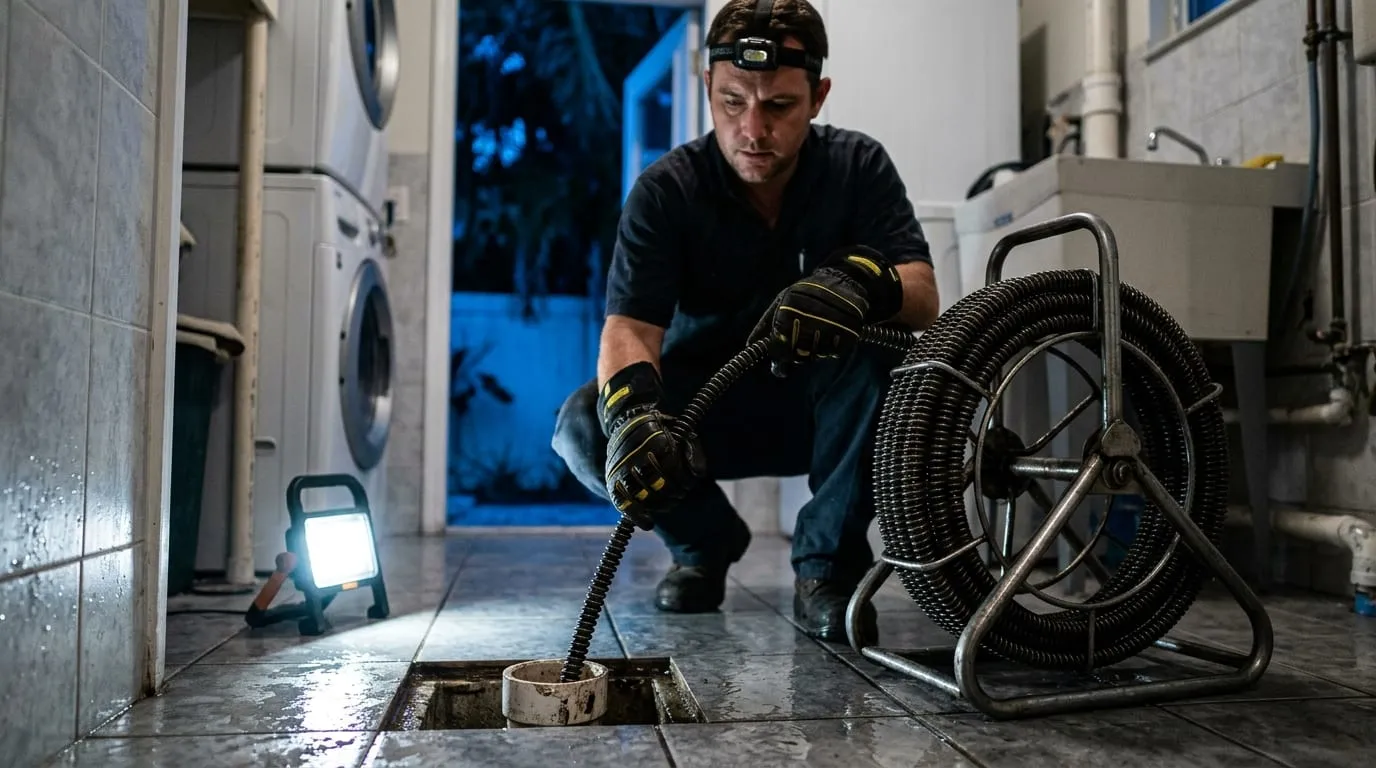
A unit connects to a shared vertical stack. What you can reach and maintain is a short branch, what actually backs up is usually the stack, and a blockage in it surfaces in the lowest unit rather than in the one that caused it.
- CFC1433655Florida plumbing contractor license
- Two systemsyour branch and the building stack
Why do condo drains block differently from house drains?
Because the geometry is different. In a house, everything you use drains into pipe that belongs to you and runs to a lateral that also belongs to you. In a condominium, each unit drains through a short horizontal branch into a vertical stack shared with every unit above and below, and that stack is where most serious blockages form.
The consequence surprises people: a blockage low in a stack does not back up into the unit that fed it. Waste from the units above arrives at the restriction, backs up, and comes out at the lowest available opening, which is a ground or low floor shower, tub or floor drain. The unit that gets flooded is frequently the one that did nothing wrong.
So prevention in a condominium is partly about your own habits and partly about a system you cannot maintain by yourself. Both halves matter, because the second is a conversation with the association rather than a job you can commission alone.
What you control
The four things that actually cause it, and what to do about each
Prevention advice for condominiums is usually the same list written for houses. These four are the ones that matter differently when the pipe is shared.
Grease, which is the main one
Grease goes down warm and liquid and does not stay that way. It cools on the way down, congeals against the wall of the stack, and builds a layer that everything else then catches on. In a house this happens in your pipe and it is your problem. In a stack it accumulates from dozens of kitchens and blocks a shared line, and no individual resident sees enough of it to feel responsible.
Nothing improves this except keeping it out. Wipe pans before washing, let fat solidify and bin it, and do not rely on hot water and detergent to carry it away, since that only moves the point at which it cools.
Wipes, including the ones sold as flushable
They pass the toilet, which is all that the word on the packet really promises, and then they do not break down the way paper does. In a shared stack they catch on grease and on each other and form the mass that ends up needing to be cut out. If a building has recurring stack blockages, this is very often what is being pulled out of it.
Hair, and the trap that is easy to reach
Shower and tub blockages are usually within the unit and usually within reach, which makes them the one category you can genuinely handle yourself. A hair catcher over the drain is unglamorous and works. What is worth avoiding is chemical drain opener: in older buildings it sits against pipe and joints it was not designed for, it does not clear a real blockage further down, and it turns the eventual mechanical clearing into a hazardous job for whoever opens the line.
The garbage disposal, which is a shared decision
Ground food waste and a long shared drain line are not a good combination, and some buildings restrict or prohibit disposals for exactly that reason. If yours has one, running it with plenty of cold water and using it for incidental scraps rather than as a way to dispose of meals is the difference that matters.
Who owns which pipe
The declaration for your building is what actually decides this, and it is worth reading rather than assuming. The common pattern is that the branch serving only your unit is the unit owner’s responsibility and the vertical stack serving several units is a common element maintained by the association. That distinction determines who commissions and pays for work, and it is why a plumber called by one owner cannot simply start jetting a shared stack.
The signal that it is not your branch
Two things point at the stack rather than at your unit. First, more than one fixture backing up at once, especially fixtures in different rooms, since a branch serves one area and a stack serves the lot. Second, water rising in a low fixture when a different unit runs water, which is the stack telling you it is full. Either of those is worth reporting to management immediately rather than clearing repeatedly, because repeated clearing of somebody else’s stack from inside your unit is a cost with no end to it.
The one preventive measure buildings actually benefit from
Scheduled cleaning of the stacks, done as maintenance rather than in response to a flood. It is an association decision and it is the only thing that addresses accumulation across every unit at once. Where a building has a history of backups in the same low units, that history is the argument for it.
Questions
Common questions about condo drains
My shower backs up when the neighbor upstairs uses water. What is that?
That is the shared stack, not your fixture. Waste is arriving at a restriction below your floor and rising to the lowest opening it can find, which is you. It is worth reporting to management rather than clearing from inside the unit.
Who pays, me or the association?
It depends on where the blockage is and on the declaration for your building. Broadly, pipe serving only your unit is yours and pipe serving multiple units is a common element, but the document governs and buildings do differ. Getting the location established before the work is what avoids the argument.
Are flushable wipes really a problem?
In a shared stack, yes, and they are one of the commonest things recovered from one. Passing the toilet is not the same as breaking down, and in a line already coated with grease they catch and accumulate.
Can I use a chemical drain opener?
It is a poor choice in an older building. It rarely reaches a real blockage further down the line, it can sit against aging pipe and joints, and it makes the eventual mechanical clearing hazardous for whoever opens the line.
Is a floor drain in the unit a good sign or a bad one?
It is neither, but it is worth knowing about, because in a low floor unit it is often the first place a stack blockage surfaces. If yours has one, note where it is before you need to.
Related
What this connects to
The pages this article usually leads to.

Live dispatch · 24 / 7 / 365
More than one fixture backing up at once?
That points at the shared stack rather than at your unit, and knowing which it is decides who does the work. A person answers at any hour.
No obligation. Work performed under Florida plumbing contractor license CFC1433655.