
Five sources · only one is urgent
A leaking toilet, and what the place it leaks from tells you
Stop the water first, then find out where it is coming from. A toilet leaks from five different places and they are not remotely equal: four are fixture repairs and one means water is getting under the floor.
- CFC1433655Florida plumbing contractor license
- Five sourcesone is not a fixture problem
What should I do first when a toilet is leaking?
Close the toilet stop valve. It is the small valve on the wall or floor beside the bowl, usually on the left, with either an oval handle you turn several times or a lever you turn a quarter turn. Clockwise closes it. Flush once to empty the tank and the leak from most sources will stop while you work out what is happening.
If that valve will not turn, or turns and the water keeps coming, go to the main shut-off for the property instead. A stop valve that has sat untouched for years commonly seizes, and forcing an old one can snap the stem and turn a drip into an open pipe.
Then do the part that decides everything else: look at where the water is actually appearing. Water on the floor at the base of the bowl is a different problem from water under the tank, and telling the two apart is worth more than any amount of tightening.
The diagnosis
Five places a toilet leaks from, worst last
Almost every toilet leak is one of five things. Working out which one you have takes a few minutes with a dry paper towel, and it changes what happens next completely.
1. From the tank into the bowl, invisibly
This is the commonest leak in any house and the one nobody sees, because the water goes straight down the drain. A flapper that no longer seats, or a fill valve that never quite shuts off, lets the tank trickle continuously into the bowl. You may hear the fill valve kick in every so often with nobody near the room, which is the classic sign.
Prove it in twenty minutes: put a few drops of food coloring in the tank, do not flush, and come back later. If there is color in the bowl, the flapper is passing. It wastes a great deal of water for something that is trivial to put right, and it is the most common reason a water bill climbs with nothing visible to blame.
2. From the supply line or the stop valve
A drip at the flexible supply hose, at its nut, or from the body of the stop valve itself. It shows up as a small puddle behind or beside the toilet rather than in front of it. This is a supply side leak: clean water, easy to see, and the least worrying of the five, though a corroded stop valve is worth replacing rather than nursing.
3. From between the tank and the bowl
Water running down the outside of the bowl, but only when the toilet is flushed, points at the tank to bowl gasket or the bolts holding the two together. It is a fixture repair and nothing is getting under the floor, but people often mistake it for a base leak, which is why the paper towel test matters: dry everything, flush, and watch where the first bead appears.
4. Condensation, which is not a leak at all
Worth naming because in this climate it fools people constantly. A tank full of cold water in a humid bathroom sweats, the tank drips onto the floor, and it looks exactly like a slow leak. If the water appears on humid days, with no relation to flushing, and the outside of the tank is beaded, that is condensation. It still needs dealing with, because water standing at the foot of a toilet eventually reaches the subfloor, but the fix is ventilation and not a wrench.
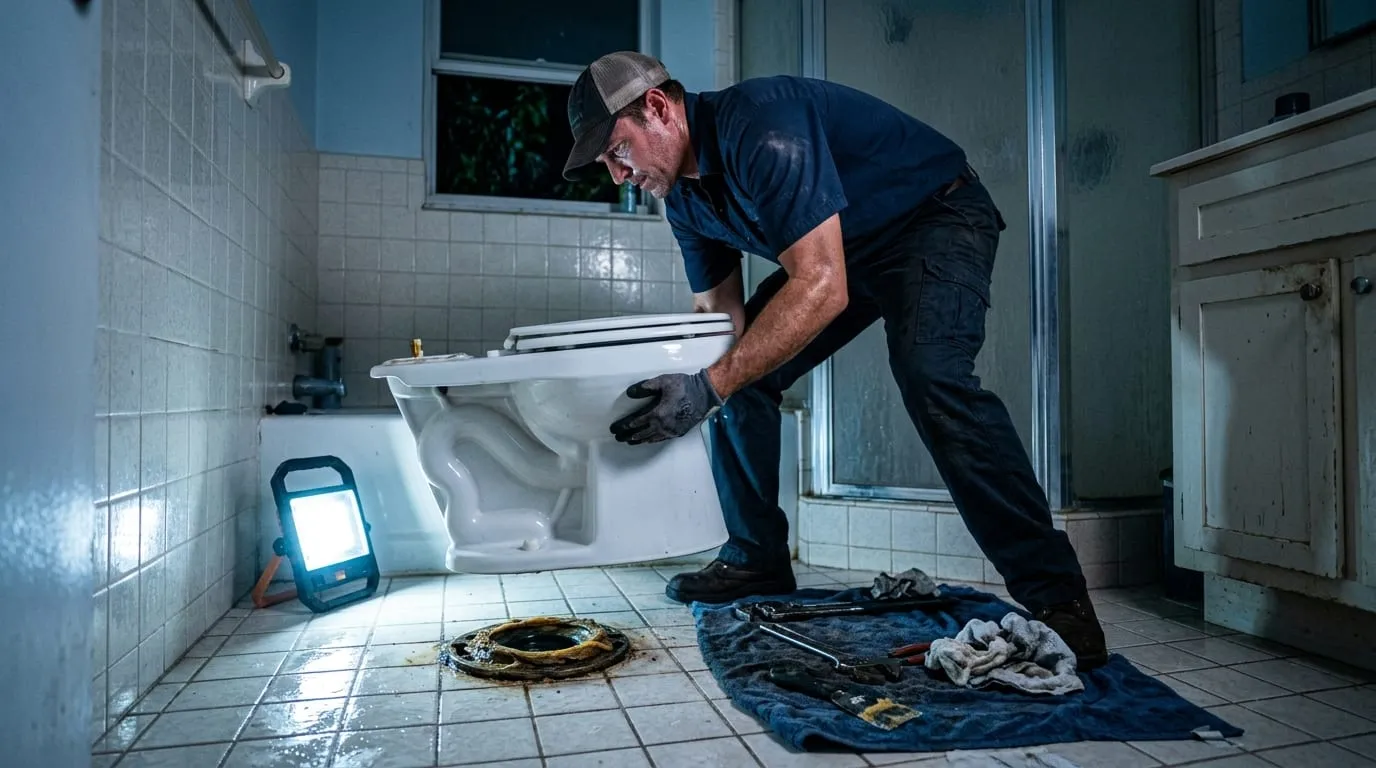
5. From the base of the bowl, and this is the one to escalate
Water seeping out around the foot of the toilet, particularly right after a flush, means the seal between the toilet and the drain has failed. What is coming out is not clean supply water: it is drain water, and it is passing under whatever flooring you have.
If the toilet also rocks when you sit down, treat that as the answer rather than as a separate observation. Movement is what destroys the seal in the first place, and continued movement will destroy any new one. In a house on slab, and nearly every house here is on slab, the closet flange the toilet bolts to is set in the concrete floor. A flange that has corroded or broken is no longer a fixture job at that point, it is a floor job, and it does not improve by being left.
What tightening the bolts will and will not do
Gently snugging the two bolts at the base sometimes stops a very new base leak. Overtightening them cracks the porcelain, which turns a seal replacement into a new toilet, so this is a quarter turn at a time and stop question rather than a lean on it question. If light pressure does not stop it, the seal or the flange has gone and no amount of force will bring it back.
Questions
Common questions about a leaking toilet
My toilet runs but I cannot see water anywhere. Is that a leak?
Yes, and it is the costliest kind precisely because it is invisible. The tank is trickling into the bowl and straight down the drain. The food coloring test in the tank settles it in twenty minutes without a tool.
There is water at the base. Can I just keep mopping it up?
Not safely. Water at the base is drain water and it is going under the flooring, not merely onto it. Every flush adds more, and the damage accumulates in the subfloor and the surrounding finishes where you cannot see it.
The toilet rocks slightly. Does that matter?
It matters more than the rocking itself suggests. Movement is what breaks the seal to the drain, so a rocking toilet either already leaks or shortly will. It usually points at the flange, the fixing bolts, or an uneven floor under the base.
The stop valve will not turn. What do I do?
Do not force it. Use the main shut-off for the property instead, and have the stop valve replaced at the same visit. An old multi turn valve that has not moved in a decade can shear, and that turns a contained problem into an open supply line.
Is a wet floor around the toilet always a leak?
No. In a humid bathroom a cold tank sweats and drips, which looks identical. Dry everything, then watch whether the water returns with flushing, which points at the fixture, or with the weather, which points at condensation.
Can I replace the seal myself?
Some people do. The reason to think twice is that lifting the toilet is the moment you find out whether the flange underneath is intact, and on a slab a broken flange set in concrete is a different job from the one you started.
Related
What this connects to
Where a toilet leak usually leads next.
Live dispatch · 24 / 7 / 365
Water coming from the base of the bowl?
That is drain water under your floor and it does not wait. A person answers at any hour and a plumber is routed to the address.
No obligation. Work performed under Florida plumbing contractor license CFC1433655.